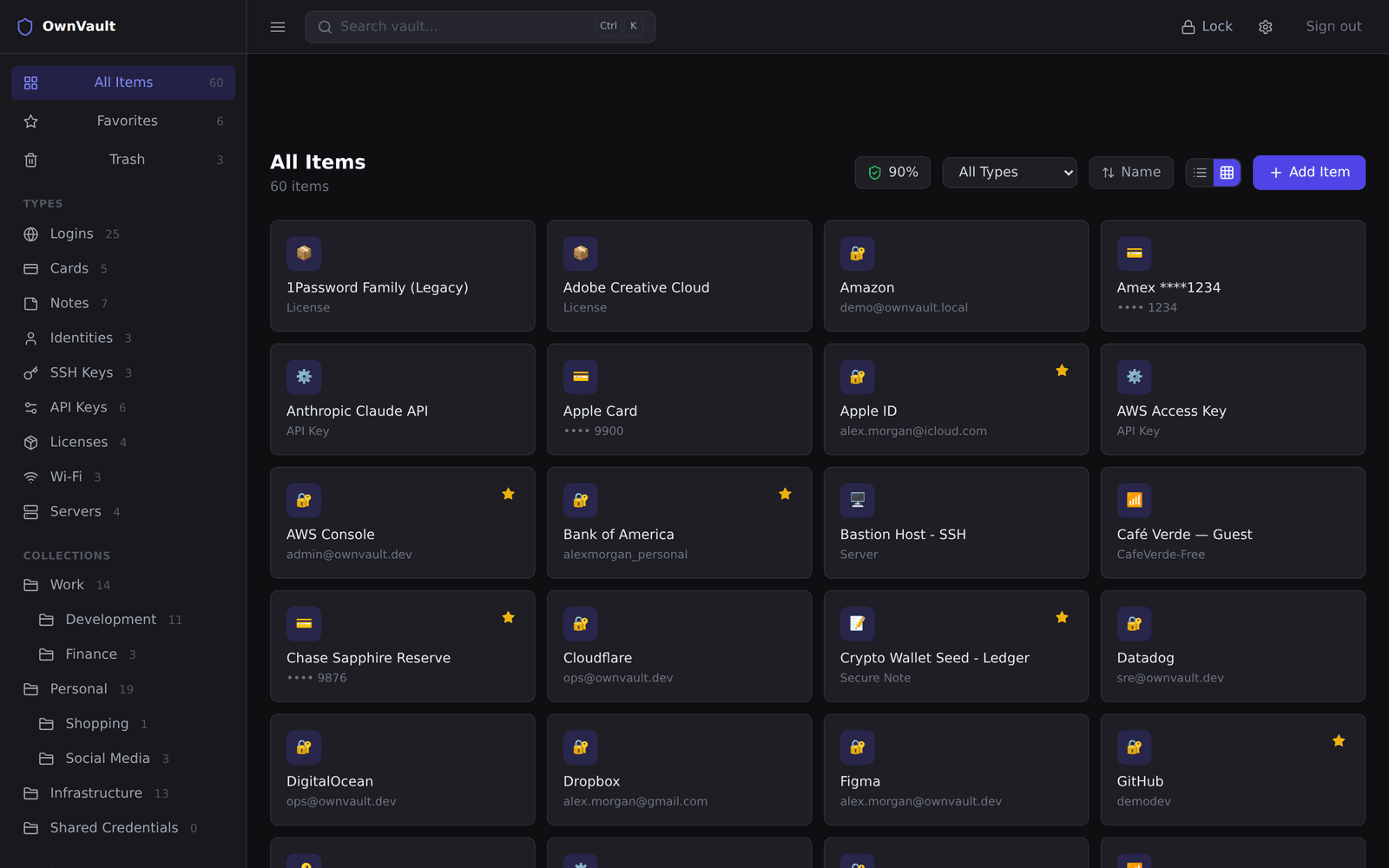
Fig 1 — OwnVault replaces 1Password, LastPass, HashiCorp Vault and runs natively on the Own360 control plane.
Why OwnVault exists
Every enterprise spends a non-trivial slice of its software budget on the engineering layer — yet most of that spend goes to vendors that hold the data, throttle the integrations, and charge per seat for features that should be commoditised. OwnVault exists to absorb that layer into something the enterprise owns end-to-end.
OwnVault is built for the teams who keep an organization's logins, API keys, and privileged access out of the wrong hands. Rather than one tool for passwords and another for infrastructure secrets, it puts every credential type — logins, cards, SSH keys, API keys, licences, notes — behind zero-knowledge encryption, then layers on scoped sharing, continuous health scoring, and cryptographic emergency access so the vault stays dependable under real operational pressure.
Centralize. Encrypt. Share. Recover.
What it replaces
Most teams reach OwnVault after running into the limits of the legacy stack:
- 1Password — team password management folds into the same vault, with scoped sharing, health scoring, and hardened multi-factor authentication built in.
- LastPass — preserved as a familiar reference point but no longer required for the workflow.
- HashiCorp Vault — infrastructure secrets move over too: SSH CA, dynamic credentials, Kubernetes injection, and a developer CLI mean no more .env files in repos.
The replacement isn't a feature-for-feature clone. OwnVault keeps the workflows you actually use, drops the ones that exist only because the underlying database was relational and the vendor wanted another SKU, and adds the things the SaaS world refuses to give you: identity sharing with every other application, a unified audit trail, and an event stream other Own360 apps can subscribe to.
Capabilities at a glance
Fig 2 — Core capability surface. Every feature publishes events to the Own360 bus and is governed by the shared control plane.
Highlights
- Zero-knowledge: AES-256-GCM with Argon2id — the platform never sees plaintext, ever
- Vault Health dashboard: continuous scoring of weak, reused, aging, and breached credentials
- Scoped sharing with time-limited grants and one-click revocation
- Break-glass emergency access via trusted contacts — no master override key
Feature surface
- Zero-knowledge Encryption. AES-256-GCM with Argon2id key derivation. Encrypted on device — the platform cannot access your secrets even if compromised.
- Vault Health. Continuous security posture: weak, reused, aging, and breached credential detection with actionable remediation.
- Scoped Sharing. Item or collection sharing with view/use/edit permissions, time-limited grants, and one-click revocation.
- Emergency Access. Cryptographic break-glass via trusted contacts with configurable waiting periods — no master override weakens the encryption.
- Hardened Auth. Passkeys, FIDO2, TOTP, biometrics, and hardware keys. Session inventory with per-device revocation.
- Governance & Billing. Plan entitlements, usage metering, licence usage tracking, and invoice history — the operating dashboard for the security programme.
The numbers that matter
Who uses OwnVault
Fig 3 — OwnVault delivers role-specific outcomes from a single shared workspace.
Security Lead. One vault for every credential type — answer 'who has access to what' in seconds, not weeks of spreadsheet auditing.
Platform Engineer. SSH CA, dynamic credentials, Kubernetes injection, and developer CLI — no more .env files in repos.
IT Admin. Company-wide credential management with health scoring, breach monitoring, and hardened multi-factor authentication.
How OwnVault fits the Own360 stack
OwnVault is one of 23+ Own360 applications that share a single control plane. The same identity provider, the same role-based access engine, the same audit log, the same event bus, and the same workflow runtime power every app on the platform.
That sharing is not cosmetic. It is what makes the platform a coherent operating layer rather than a federated bag of SaaS tools. A permission grant in OwnCentral instantly affects OwnVault. An event emitted by OwnVault can trigger a workflow in OwnFlow. An audit record from OwnVault surfaces in the same query as one from OwnERP. There is no integration project — only configuration.
Operational economics
The Own360 commercial model is deliberately simple and decidedly not per-seat. Every Own app — including OwnVault — is source-available, self-hostable, and licensed perpetually. The 10-year cost curve flattens because there is no annual seat inflation, no AI add-on SKU, and no vendor lock-in tax on the data you produce.
For finance leaders, this turns an OpEx subscription stream into a one-time CapEx outlay plus a small support footprint. For engineering leaders, it turns a vendor integration roadmap into an internal product roadmap. For security leaders, it eliminates the "data lives at someone else's URL" risk entirely.
Frequently asked questions
What is OwnVault?
OwnVault is the Own360 product for "Centralize. Encrypt. Share. Recover." in the Engineering layer. It is a zero-knowledge vault that holds every credential type a team depends on — logins, cards, SSH keys, API keys, licences, and notes — with scoped sharing, continuous health scoring, and cryptographic emergency access built in.
What does OwnVault replace?
OwnVault is designed to replace 1Password, LastPass, HashiCorp Vault with a single owned, governed surface that runs on the Own360 control plane.
Who uses OwnVault?
Security Lead: One vault for every credential type — answer 'who has access to what' in seconds, not weeks of spreadsheet auditing. Platform Engineer: SSH CA, dynamic credentials, Kubernetes injection, and developer CLI — no more .env files in repos. IT Admin: Company-wide credential management with health scoring, breach monitoring, and hardened multi-factor authentication.
How does OwnVault fit into the Own360 stack?
OwnVault runs on top of the Own360 control plane — sharing identity, permissions, audit, and workflow services with every other Own product. There is no separate SSO setup, separate audit log, or separate integration layer. The same governance and event bus apply.
Is OwnVault self-hosted?
Yes. The entire Own360 platform — including OwnVault — is designed to run inside your VPC, your on-prem data centre, or a sovereign cloud. Source-available with perpetual licensing; no per-seat tax, no data egress, no telemetry leaving your boundary.
Related products in the Engineering layer
- OwnData — Federate. Govern. Stream. Serve.
- OwnBI — Visibility. Analytics. Insights. Decisions.
- OwnFlow — Automate. Integrate. Orchestrate. Self-Hosted.
- OwnETL — Extract. Transform. Load. Monitor. Govern.
See it live
OwnVault is part of the Own360 platform demo. Get in touch for a walkthrough, or browse the rest of the product stack to see how the layers compose. Full specs, metrics, and licensing live on the OwnVault product page.